Mechanical access · 01
CanSat competition
CanSat
CanSat challenges student teams to build a working satellite-style payload inside the volume of a soft-drink can, then collect useful telemetry during descent.
In our first year, our team of three reached the national finals with a complete mechanical, electronics, telemetry and recovery system.

Serviceability · 02
Four screws release the electronics.
The complete electronics stack lifts out as one unit, making it quick to change components, service the system, or replace the batteries.01 · Component
Standoffs
Set the board-to-board spacing so the three-layer stack stayed aligned while leaving room for wiring, sensors and the battery pack.02 · Component
Arduino
Ran the flight logic: reading sensors, packaging telemetry and coordinating the electronics during descent.03 · Component
Master PCB
The main interconnect board for power, signals and board-to-board routing across the payload.04 · Component
Sensor PCB
A dedicated electronics layer for environmental and motion measurements, keeping the sensor routing clear inside the stack.05 · Component
Battery pack
Packed onboard power into the remaining internal volume while keeping mass placement predictable for descent.06 · Component
LISDH accelerometer
A three-axis accelerometer used to record changes in motion and shocks during launch and descent.07 · Component
BMP280
Measures pressure and temperature. It drove our secondary mission: using flight data to prove the pressure-altitude equation.08 · Component
Top PCB
The top electronics layer kept the upper connections serviceable while completing the compact three-board structure.09 · Component
LoRa radio
The long-range radio link that sent sensor packets back to the ground station for analysis during the mission.10 · Component
GPS
Captured position and time so telemetry could be tied to a flight path and recovery location.Mission objectives
Sense the flight. Return useful data.
Capture position, pressure, temperature and motion inside a can-sized payload, then transmit the telemetry over LoRa.What I learned
Integration is the real engineering problem.
CAD, PCB layout, power, sensing, firmware and manufacture all had to be designed as one compact system.Loading assembly · 0%
01 · My responsibilities
What I was responsible for.
In a team of three, my work centred on making the mission physically possible: packaging the electronics, creating the boards and engineering the complete recovery system.
MECH / 01★
CAD + packaging
Mechanical
I used Fusion 360 to model the enclosure and internal electronics stack around the can-sized volume, checking board spacing, battery clearance, screw fixings and access so the payload could be assembled and tested quickly.
- Fusion 360
- Can-sized stack
- Board spacing
ELEC / 02★
PCB design
Electronics
I learned PCB design from scratch during the build, designed the electronics as a three-board stack and had the boards ordered within one month.
- Three-board stack
- Sensor routing
RECOVERY / 03★
Descent system
Parachute
I worked through the descent calculations, then fabricated the recovery system myself by sewing the calculated canopy and suspension lines into a packable parachute.
- Descent maths
- Sewn canopy
02 · Technical documentation
Designed, drawn, and explained.
The physical payload was only one part of the submission. The drawings turned a dense mechanical and electronic stack into something the team could inspect, assemble, and communicate clearly.
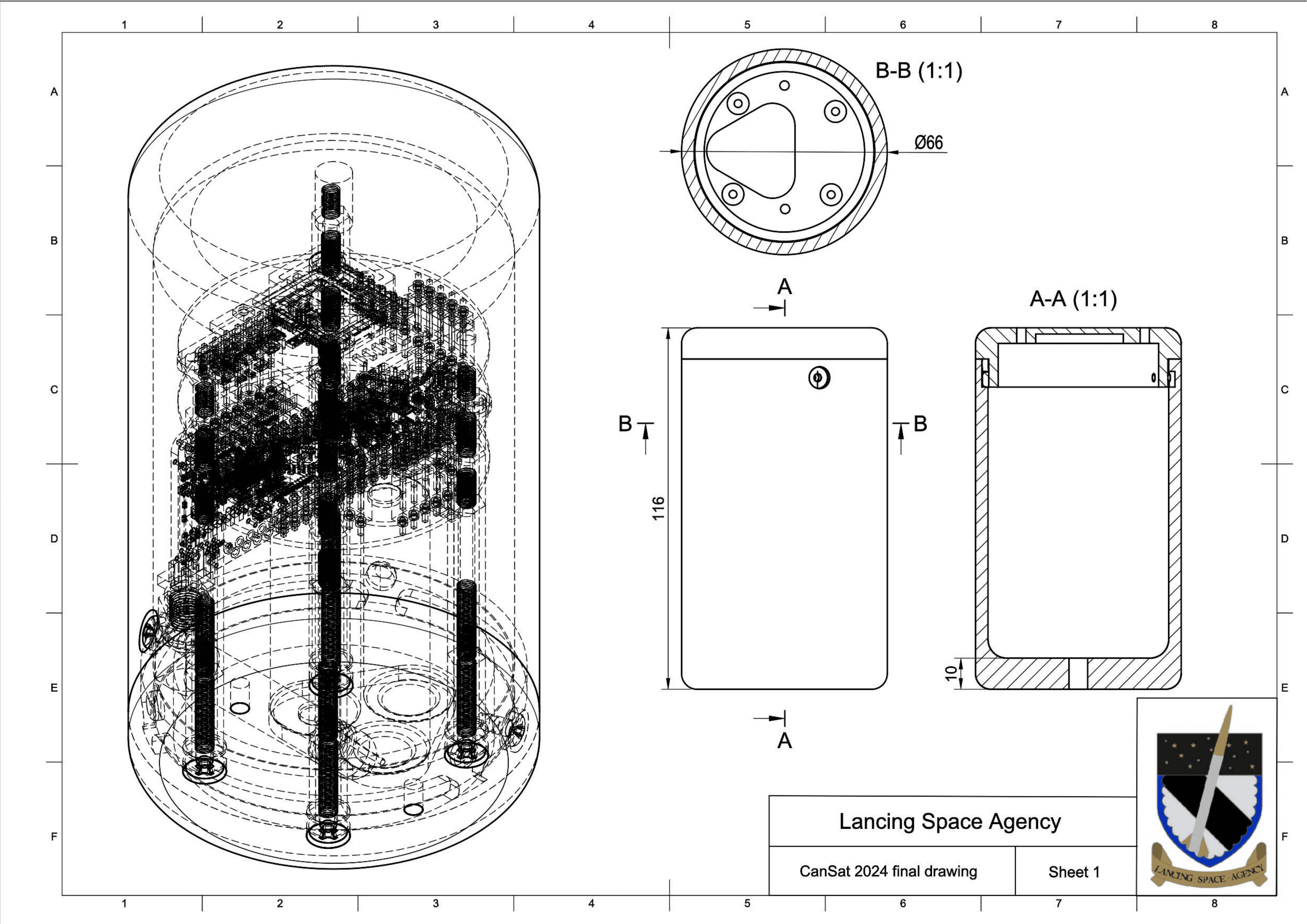
The assembled package, section views, and 66 mm by 116 mm envelope made the spatial constraints reviewable before manufacture.
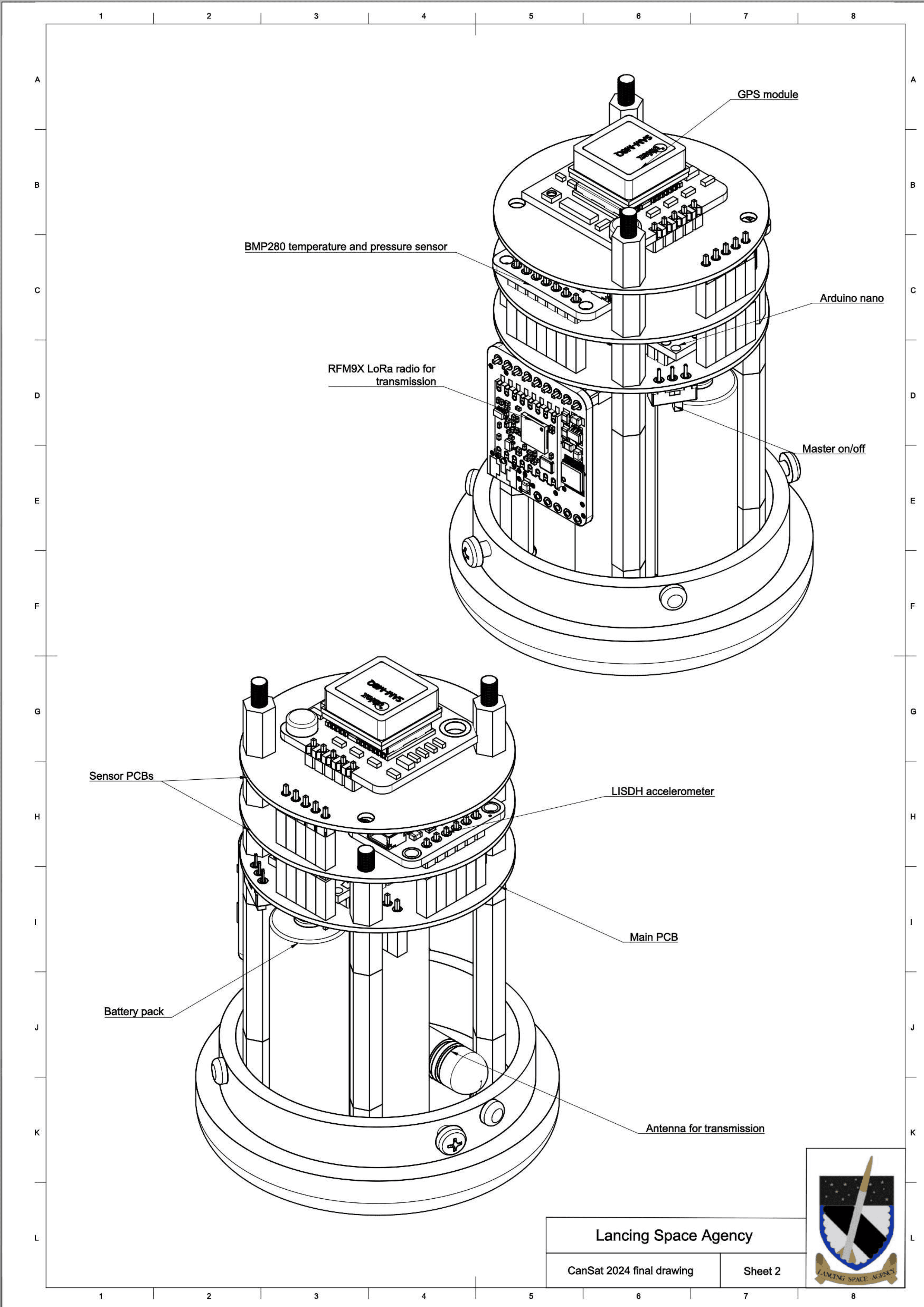
Component callouts connect the physical stack to the sensing, processing, power, and LoRa telemetry architecture.
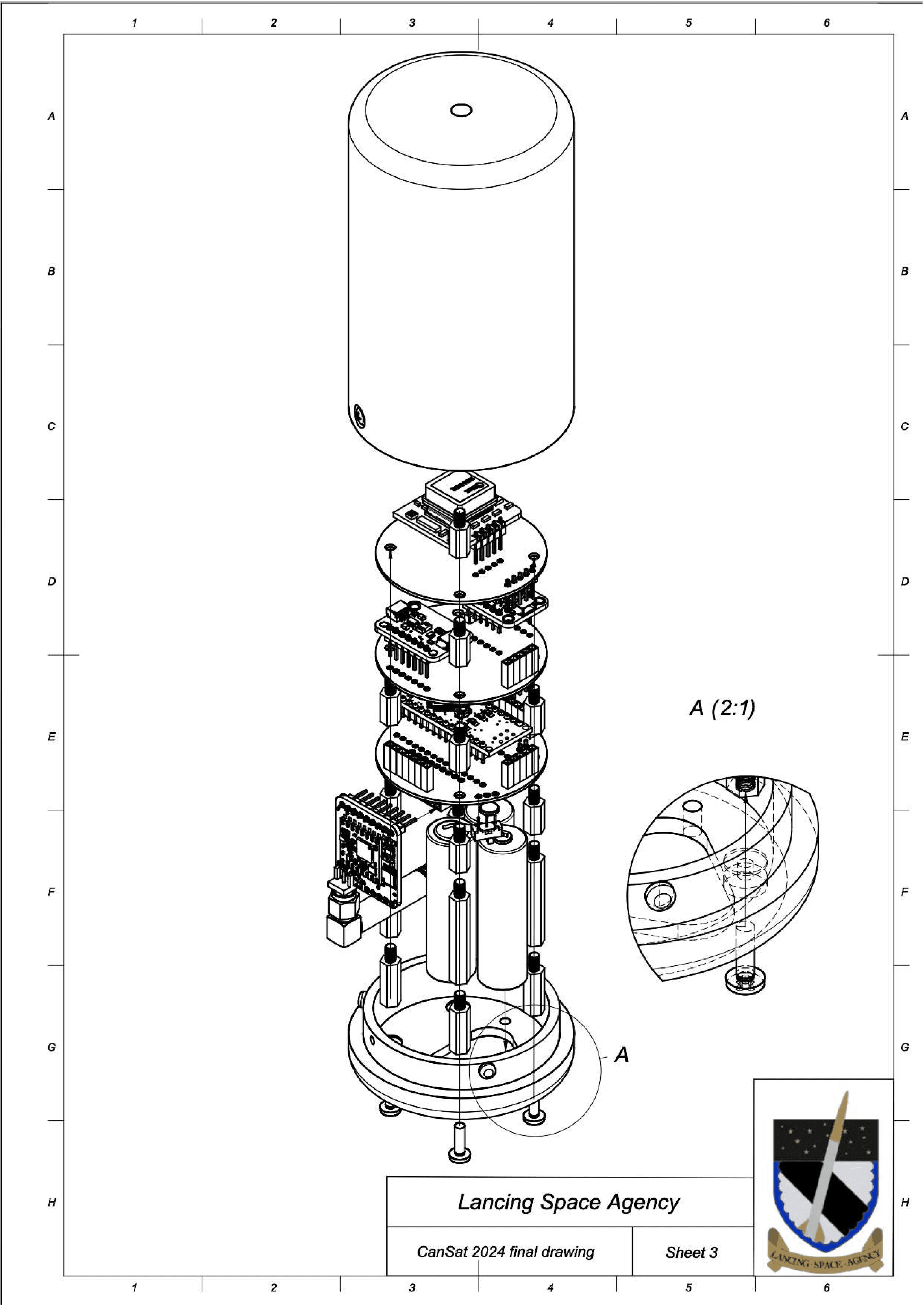
The exploded view records the assembly order, board spacing, structure, enclosure, and serviceable fixings.